Hey everyone. So tomorrow is the last day of class and so this blog must come to an end. I hope everyone enjoyed it as much as I enjoyed writing it. This blog has not only enabled me to learn about a ton of things I had never heard of but it also educated me on how others view nuclear energy.
Although this blog is ending, the story of nuclear energy will never end. And, you the public should remember to always arm yourselves with facts about any and everything so when the time comes...you know what's going on. There are many more sites out there that can help you in your quest for nuclear knowledge:
NEI Nuclear Notes
This Week in Nuclear
and as always Google News
I never thought this blog would become so popular with audience coming from so many different places in the world. Makes me sad to end it...but all good things must come to an end. As for me, I was recently accepted into the Nuclear Engineering Graduate Program at CSM and so nuclear energy is definitely in my future and I hope it will also be in everyone else's.
Thanks guys.
"Not every end is the goal. The end of a melody is not its goal, and yet if a melody has not reached its end, it has not reached its goal. A parable." Friedrich Nietzsche

Tuesday, May 3, 2011

Monday, May 2, 2011
Tiny Science...Big Potential
Just a quick post on something I found really cool. I recently had to give a presentation in my Extraction of Rare Earth Metals class about the rare earth promethium. One of the few applications of promethium is for the use in nuclear batteries. So this got me wondering about just that...nuclear batteries.
So I went into researching them and came across a really neat story from CNET. The story is about scientists at the University of Missouri who are developing a nuclear battery...or as they call it "radioisotope battery", that is about the size of a dime but holds over a million times the charge as a normal battery. The developer Jae Kwon even states that with the right materials it may be possible to make the battery the thickness of a human hair.
Just so everyone knows...the basic concept behind a nuclear battery is that energy from released particles due to radioactive decay is transformed into a current and thus power can be produced. Nuclear batteries are already used to power many things from pacemakers to space satellites. Who knows where else these awesome little buggers could be used!
 |
| Credit: University of Missouri |
So I went into researching them and came across a really neat story from CNET. The story is about scientists at the University of Missouri who are developing a nuclear battery...or as they call it "radioisotope battery", that is about the size of a dime but holds over a million times the charge as a normal battery. The developer Jae Kwon even states that with the right materials it may be possible to make the battery the thickness of a human hair.
Just so everyone knows...the basic concept behind a nuclear battery is that energy from released particles due to radioactive decay is transformed into a current and thus power can be produced. Nuclear batteries are already used to power many things from pacemakers to space satellites. Who knows where else these awesome little buggers could be used!
Saturday, April 30, 2011
The Answer is with ITER
As I mentioned in my last blog post, the problem with fusion reactors (and therefore the reason they are not commercially used) is that you must put more energy into the fusion process than there is energy that you get out. Until this critical problem is solved, all nuclear plants will remain fission reactors.
Many of you have probably heard of ITER, the International Thermonuclear Experimental Reactor. ITER was designed to end fusion's "less energy out" problem. Idealized in 1985, at the Geneva Summit, ITER was a project aimed at using fusion energy for peaceful purposes. By the end 2005, the USA, Russia, the European Union, Japan, South Korea, and India had all signed up (today also includes China). Site preparation for ITER began in 2007 in Cadarache, France.
So what exactly is ITER? Once completed, ITER will be the world's largest tokamak (Russian word for the "doughnut" shape) nuclear fusion reactor. Tokamak refers to the shape of the actual reactor which can be seen below. The tokamak shape is necessary for aiding the shape of the magnetic fields needed in the reactor.
The reactor hopes to achieve an output of about 500 MW with an input of only 50 MW. Therefore solving the fusion problem. One of the most difficult requirements of a fusion reactor is the high temperature, up to 150 million degrees Celsius. ITER uses several engineering feats in order to achieve such a temperature however, due to its complexity the details of ITER's design will not be discussed, but do not fret HERE is a cool link that will let you explore all of the different parts of the reactor. The ITER's tokamak hopes to be completed by 2018.
ITER is important in many ways. If ITER could prove successful... and we could finally be productive in the fusion process...the Earth's energy problems would be forever solved (oh wow big statement). No more radioactive by-products as with fission reactors!
Many of you have probably heard of ITER, the International Thermonuclear Experimental Reactor. ITER was designed to end fusion's "less energy out" problem. Idealized in 1985, at the Geneva Summit, ITER was a project aimed at using fusion energy for peaceful purposes. By the end 2005, the USA, Russia, the European Union, Japan, South Korea, and India had all signed up (today also includes China). Site preparation for ITER began in 2007 in Cadarache, France.
So what exactly is ITER? Once completed, ITER will be the world's largest tokamak (Russian word for the "doughnut" shape) nuclear fusion reactor. Tokamak refers to the shape of the actual reactor which can be seen below. The tokamak shape is necessary for aiding the shape of the magnetic fields needed in the reactor.
 |
| JET, located in the UK notice "doughnut" shape. |
The reactor hopes to achieve an output of about 500 MW with an input of only 50 MW. Therefore solving the fusion problem. One of the most difficult requirements of a fusion reactor is the high temperature, up to 150 million degrees Celsius. ITER uses several engineering feats in order to achieve such a temperature however, due to its complexity the details of ITER's design will not be discussed, but do not fret HERE is a cool link that will let you explore all of the different parts of the reactor. The ITER's tokamak hopes to be completed by 2018.
ITER is important in many ways. If ITER could prove successful... and we could finally be productive in the fusion process...the Earth's energy problems would be forever solved (oh wow big statement). No more radioactive by-products as with fission reactors!
Tuesday, April 26, 2011
Making a Star
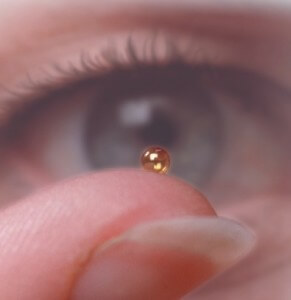 |
| "Fuel" used at NIF, the tiny capsule is filled with deuterium-tritium. |
The last few weeks in my Nuclear Energy class, we have been discussing the possibilities of fusion energy. Fusion energy is a lot different than the current fission reactors the world uses today because no radioactive by-products are formed. However, as of right now there is no method for producing energy from fusion that generates more money than is put in to the reaction. This is because fusion occurs at extremely high temperatures.
So this morning, my professor who has dedicated his life to the research of fusion energy was discussing some of the places he had previously worked. He showed us this slide show of which some of it pertained to NIF, the National Ignition Facility in Livermore, California. And then he talked about what goes on in this place...wow. As mentioned earlier, one of the problems with fusion energy is actually getting the reaction to reach temperatures higher than that of the interior of our sun. So the goal of NIF was to work on just that..."igniting" the reaction.
Although, this is somewhat "old" news...I myself (not coming from a physics background) did not know much about it. I don't want to spoil what goes on at NIF because I know that this video will explain it much better than I can. Short and simple: A lot of big lasers shoot at a tiny, tiny sphere of fuel...thus concentrating their energy on one spot and igniting the fuel. Please check out the video (look past the corny 3rd grade science class feel)...it's really amazing.
Sunday, April 24, 2011
Come on Nevada...be more like Osthammar
 |
| Storage of spent nuclear fuel in facility at Oskarshamn, Sweden |
I read the most interesting article today containing information that I never thought I would ever read. A town in Sweden, a country that receives over 50% of its electricity from nuclear energy, claims that it will gladly take the nuclear waste from Sweden's reactors. What?!?! Is this for real?
Osthammar, residents were recently polled and the results were amazing. Over 88% of the residents said that they were in favor of allowing thousands of tons of nuclear waste to be stored under their town.
So now the plan is to bury some 12,000 tons of nuclear waste in copper containers 500 meters underground for over 100,000 years. Osthammar, was chosen for this task because the town sits a top billion year old bedrock. Apparently, the locals are in favor of such an act because they grew up next to the nuclear plant in Forsmark. Their family and friends work there and they have become accustomed to nuclear.
Currently, Sweden has 5,000 tons of nuclear waste stored at a facility in Oskarshamn. It's stored in an eight meter deep water tank approximately forty meters underground. However, even with all the safety precautions (water shielding and underground) the plant is still monitored 24-7-365. Sweden wants to find another way, and with more nuclear waste being made all the time something more efficient has to be done.
Makes you wonder if we could ever see something like this happening in the USA...
"Individual commitment to a group effort-that is what makes a team work, a company work, a society work, a civilization work." Vince Lombardi
Saturday, April 23, 2011
Beryllium + Uranium = Awesome
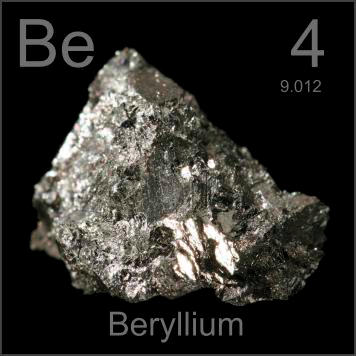
"This seven gram sample is $70,000..." What? Yes that's right. Last Wednesday in my Processing of Rare Earth Metals class we had a guest speaker from a beryllium processing company. The lecture blew me away! Beryllium is such an amazing element with many uses in the modern world ranging from nuclear reactors to satellites.
After that class got me so interested in the many uses of beryllium (and also talks from my nuclear energy class on beryllium for fusion reactors) I began to do a little research on the element. My research led me to an article from World Nuclear News about an ongoing research project between Canadian company IBC Advanced Alloys, Purdue University, and Texas Engineering Experiment Station. The project is a study of the possibility of using beryllium oxide fuels for both current and future nuclear reactors.
I'd like to discuss some of the findings from their research, but remember this is research and not commercially applied technology. According to IBC, the use of beryllium oxides with uranium oxide as fuel for nuclear reactors improves the longevity, efficiency, and how safe the actual process is. These benefits are most likely due to the increase in thermal conductivity of the fuel by the addition of the beryllium oxide (uranium dioxide has a very low thermal conductivity). Turns out beryllium oxide does not react with uranium dioxide until temperatures of about 21,000 degrees Celsius.
So they have made a great discovery, but their challenge now lies in coming up with an economically viable method for combining the two oxides to produce fuel. They are currently working on a co-sintering method that would result in a granules of uranium dioxide completely surround by beryllium oxide, which would result in production of the fuel by means of small pellets.
If this proves to be as good as it sounds it could be great news for the nuclear industry. If we could come up with a way to make the same fuel we already use last a little longer...that would mean less radioactive waste. And less radioactive waste is what everyone has been asking for.
Tuesday, April 19, 2011
Chernobyl's Future
On April 29th, 1986 the worst nuclear power accident ever witnessed occurred in the Ukraine. Today, Chernobyl sits alone in what some refer to as the "Zone of Alienation". It is a 30 kilometer zone surrounding the once nuclear reactor site which was initiated in order to prevent people from entering the heavily radiated zone. All types of activities in the "zone" not related to the scientific study of nuclear reactor safety or pertaining to work at the nuclear site are illegal.
So what is going on there today. Well...first some history...less than a year after the accident, the nuclear plant was encased in a concrete "sarcophagus" in order to shield the still radiating nuclear fuel. However, because the concrete wall has begun to crack...safety precautions must be taken and a new encasing must be constructed. Ukraine has been trying to come up with the money to build a 20,000 metric ton steel arch that would replace the current concrete "box". The steel shell is said to prevent any radiation leakage from the plant for over 100 years. So after years of persuasive talks from the Ukraine, governments all over the world have pledged money to the construction of the steel arch. And now ten days away from the 25th anniversary of the accident, it seems that they have met their financial goal.
Below I've provided a short video that describes all of the details...check it out...it displays some great engineering!
So what is going on there today. Well...first some history...less than a year after the accident, the nuclear plant was encased in a concrete "sarcophagus" in order to shield the still radiating nuclear fuel. However, because the concrete wall has begun to crack...safety precautions must be taken and a new encasing must be constructed. Ukraine has been trying to come up with the money to build a 20,000 metric ton steel arch that would replace the current concrete "box". The steel shell is said to prevent any radiation leakage from the plant for over 100 years. So after years of persuasive talks from the Ukraine, governments all over the world have pledged money to the construction of the steel arch. And now ten days away from the 25th anniversary of the accident, it seems that they have met their financial goal.
Below I've provided a short video that describes all of the details...check it out...it displays some great engineering!
Sunday, April 17, 2011
Cassini: In-Depth Look
Recently, I published a post on the Cassini spacecraft that currently orbits Saturn. I received a comment from a reader stating that they wanted to know more about the process of actually using the alpha decay process of the plutonium for power.
I will apologize ahead of time but to have answered the question I had to use some technical/science terms.
A definition you will need:
Thermocouple: a kind of thermometer consisting of two wires of different metals that are joined at both ends; one junction is at the temperature to be measured and the other is held at a fixed lower temperature; the current generated in the circuit is proportional to the temperature difference.
This is a great question and I have to admit that I had to do some research in order to answer it because it is different from how nuclear power plants work (which makes total sense). Turns out that Cassini is powered by three...wait for it...radioisotope thermoelectric generators. Big word but here is a simple explanation of what it does: an RTG uses heat from radioactive decay in order to generate electricity by use of thermocouples. In Cassini's case the heat was from the energy coming from the radioactive decay of plutonium. The explanation of the process can get quite technical but I will simply put it that an RTG relies on temperature differences in order to create a voltage.
An RTG consists of the fuel, plutonium, which is kept in some sort of container. Thermocouples are hooked up to the container and the heat produced from the radioactive decay allows for electricity to be generated. You can see the RTGs at the bottom of the Cassini spacecraft on the image below.

RTG's can use fuel other than plutonium (i.e. strontium, polonium, curium, etc.) however, plutonium requires the least amount of lead shielding (2.5mm) in order to contain the radiation. And when you are designing a spacecraft, the weight of everything on board is extremely important. Plutonium also had an optimal half-life (87 years) for the mission...meaning that it should have a continuous release rate of energy for an optimal amount of time (in Cassini's case it needed to power for at least 11 years).
I will apologize ahead of time but to have answered the question I had to use some technical/science terms.
A definition you will need:
Thermocouple: a kind of thermometer consisting of two wires of different metals that are joined at both ends; one junction is at the temperature to be measured and the other is held at a fixed lower temperature; the current generated in the circuit is proportional to the temperature difference.
This is a great question and I have to admit that I had to do some research in order to answer it because it is different from how nuclear power plants work (which makes total sense). Turns out that Cassini is powered by three...wait for it...radioisotope thermoelectric generators. Big word but here is a simple explanation of what it does: an RTG uses heat from radioactive decay in order to generate electricity by use of thermocouples. In Cassini's case the heat was from the energy coming from the radioactive decay of plutonium. The explanation of the process can get quite technical but I will simply put it that an RTG relies on temperature differences in order to create a voltage.
An RTG consists of the fuel, plutonium, which is kept in some sort of container. Thermocouples are hooked up to the container and the heat produced from the radioactive decay allows for electricity to be generated. You can see the RTGs at the bottom of the Cassini spacecraft on the image below.

RTG's can use fuel other than plutonium (i.e. strontium, polonium, curium, etc.) however, plutonium requires the least amount of lead shielding (2.5mm) in order to contain the radiation. And when you are designing a spacecraft, the weight of everything on board is extremely important. Plutonium also had an optimal half-life (87 years) for the mission...meaning that it should have a continuous release rate of energy for an optimal amount of time (in Cassini's case it needed to power for at least 11 years).
I hope this helps!
Friday, April 15, 2011
NASA's Cassini...Thank You Plutonium

In an attempt to cure my terrible case of writer's block, I have decided to possibly go into a series concerning "other benefits of nuclear energy/radioactive materials". For my first attempt I would like to discuss something historical...and one of my favorite subjects.
I love anything and everything to do with space. Planets, stars, spacecrafts, shuttle missions, space stations, galaxies, and my favorite: planetary dust aggregation...you name it...I'm interested. So you could have imagined how shocked I was in nuclear energy class this week when my fellow students discovered for the first time that the successful Cassini mission (all the way to Saturn) was powered by plutonium 238.
Most spacecraft missions are powered by solar rays but because of Saturn's distance...Cassini was going to need something different. Therefore the idea was to use approximately 72 pounds of 238Pl. The heat given off by the alpha decay process of plutonium would fuel Cassini for the entire 11 year trip (awesome). Of course, nuclear energy has had enemies throughout all of history, and at one point the mission was almost canceled due to a high turnout of protesters. Many claimed that if the Cassini exploded as the Challenger did in 1986, it would spread high amounts of plutonium all over Florida. But NASA prevailed and went on with the project and launched Cassini in 1997. Loaded up with its 72 lbs of plutonium it was on its way...and to gain momentum throughout the flight all the way to Saturn, it performed several gravitational slingshot procedures when within distance of other planets (this actually means that it went the wrong way first-towards Venus- in order to gain momentum from Venus twice and then Earth before starting its real trip).
At this very moment Cassini orbits Saturn and delivers data to us. Here is a great link to one of NASA's pages that describes all of the Cassini events happening this year! Cassini has brought so much valuable information into our hands...more than we could ever have dreamed of. In 2004 alone, Cassini delivered images to us that allowed for the discovery of three new moons! And just think that this was only possible because scientists were able to understand the decay processes of radioactive elements and NASA was able to carry through with the project despite massive protests.
Tuesday, April 12, 2011
Saturday, April 9, 2011
Dr. Cecil Presents: Basic Science of Nuclear Reactor Meltdown

Last Thursday, I attended a presentation by Dr. Ed Cecil, Colorado School of Mines Professor, which covered the basic science behind nuclear reactor meltdowns. I thought it would be interesting to attend a short presentation about a subject I already understand in order to see how Dr. Cecil would portray the complex information of nuclear physics and engineering to an audience of non-nuclear junkies and do it in less than an hour.
He started off with the simple idea of a nuclear power plant..."it works just like any other power plant setup" that is it contains a steam generator that spins a turbine for power. Everyone can get that...right?

He explained to the audience that from the binding energies one can determine that the average fission process gives off 200 MeV's of energy and that by using that number we can calculate that we only need 10 kg of uranium to supply a 1 GW reactor for 6 months (AWESOME). Cecil accidentally stumbled onto the "iron death of the universe" but he quickly recovered himself.
Well that's all great and dandy, but most importantly Cecil discussed the problems with nuclear power and how to interpret "radiation". Two topics I feel that the public today knows only enough to be dangerous about. On the first point, a downfall of nuclear power is the decay products left over from the process. Below is one of Cecil's slides listing the radioactive by products.
Q. So what are the radioactive by products of nuclear fission?
A. Lots and lots:
•Isotope Half-life Fraction per fission
•137Cs, 137Xe,… 30 yr, 8 min,… 6.2%
•90Sr, 90Rb,…. 28 years, 4 min,.. 5.8%
•144Ce,….. 284 days,… 5.5%
•95Zr,… 64 days, 6.5%
•etc. etc. etc
•131I,… 8 days,… 2.9%
• Total = 200%
It's because of those elements with half lives of 30ish years that we have to come up with ways of safely storing the waste. (i.e. the shorter half life elements will eventually decay away...but it takes 30 years for some of them)
Another great topic that Cecil discussed was how to interpret radiation. People have become afraid of the word radiation...and I don't blame them. But you have to realize that radiation must be quantitatively described in order to know if it is really dangerous or not. In our world today we have background radiation of up to 0.1 rem/ yr. Bananas alone give off about .0001 rem/yr...should we all be running away from bananas? No. For example, the max dose for industry (nuclear submarine workers or nuclear plant workers) is approximately 10 rem/yr. Therefore, before the public goes off and reads articles about how high the radiation levels are somewhere...they need to educate themselves on what exactly is a "high" number. It was just the other day in my nuclear energy class when we read an article about Fukushima. The article had a quote in there about how "tiny amounts of radiation were leaking..." so what exactly does "tiny" mean. Who knows.
One last thing that I would like to bring up that Dr. Cecil discussed was just a small historical fact. There are a lot of people out there that bring up Chernobyl whenever nuclear power is discussed. Well, yes everyone knows that Chernobyl was a sad day, but there are quite a few of us that don't understand that there was something different about Chernobyl than with every other nuclear reactor in the world. Chernobyl was designed to operate at a criticality above one. Everybody but Russia seemed to realize that this was a bad idea...Russia was warned repeatedly but still went ahead with plans and built the reactor. That design failed just like everyone knew it would.
Bravo Dr. Cecil, what a daunting task to try to explain most of how a nuclear reactor works and about radiation in less than an hour. The talk was a bit jargony but we were all engineers in there so... I hope those 40 some people all went home armed with accurate knowledge about nuclear energy.
Thursday, April 7, 2011
Social Media Sites Dig Nuclear Energy (the graph says so)
Sorry but I just had to make a little blurb about something I found...it reminds me a lot about what we were doing in class with the BP presentations. For example, comparing how media reports certain controversial topics and how geography also affects what is reported. So, I just stumbled upon a site called Social Radar that monitors social media sites to understand how hot topics are being discussed. For those who have no idea what it is (like I didn't) Social Radar's site says: "Social Radar is a social analytics application that collects billions of articles and messages from millions of sources such as blogs, social networks, news sources, microblogs, forums, and more to provide instantaneous insights and measurement into online chatter." It can even count positive vs negative talks on a subject and where in the world the talking is coming from. Cool, huh?
I pulled up the nuclear energy topic on Social Radar...turns out that they had a graph specifically made to describe the social media conversations from before the Fukushima incident to after. Social radar even determined if the conversation had positive or negative (describing nuclear energy) context. The graph (below) actually has some really interesting data.
Before the accident, most of the social media conversations about nuclear energy were "positive". However, once the Fukushima incident happened negative comments took over, which we all could have predicted. The surprising part is that now it seems that people are once again talking positive. I knew nuclear energy would overcome this...but that was fast.
I pulled up the nuclear energy topic on Social Radar...turns out that they had a graph specifically made to describe the social media conversations from before the Fukushima incident to after. Social radar even determined if the conversation had positive or negative (describing nuclear energy) context. The graph (below) actually has some really interesting data.
 |
| Graph from Social Radar |
Monday, April 4, 2011
Don't Eat the Yellowcake: Uranium Mining
There are a lot of us out there that don't exactly understand the processes behind "mining" uranium. It's actually a lot like the mining processes for other materials. People seem to have this notion that uranium is a very rare commodity when actually the earth's crust has about a 2.8 parts per million concentration of uranium, about the same as tin. My expertise is actually in the metallurgy field which is greatly connected with mining, so I want to take the time to clear up some misconceptions (hopefully) and explain just how uranium is mined.
There are three main types of uranium mines out there: In Situ, Open pit /underground, and heap leaching.
In Situ leaching (or solution mining) of uranium can be used if an orebody lies in some type of porous material and in ground water. Bore holes are drilled through the ore body and subsequently a leaching solution is poured down the bore holes. Once the leaching solution comes into contact with the ore body it dissolves the wanted material and thus when it is pumped back up to the surface the solution now contains uranium. The uranium is then recovered as a precipitate. Common leaching solutions used for uranium are sulfuric acid or sodium bicarbonate (but others can be used). One benefit of in situ leaching is that it has little ground disturbance (vs. open pit/underground mining) and there is no need for crushing.
Open pit and underground mining of uranium is pretty self explanatory (it's probably the picture that comes to mind when we all think of "mining"). If the uranium deposits are located somewhat close to the surface then open pit mining is preferential. A large pit is made and piles of ground material (uranium plus the rock material) are removed and sent to a processing/separation facility. All of the material will be crushed and then leached with an acid in order to dissolve the uranium oxides. Once uranium oxides are dried out (85% uranium by mass at this point) the resulting product is what we all know as "yellowcake". This is then packed into steel drums and sent to where they are needed. Underground mining is generally the same expect for the uranium deposits sit deeper within the crust and so tunnels must be dug into the ground in order to mine the uranium. These two options are by far the most popular, they account for 57% of the uranium mines.
Finally, heap leaching is very similar to in situ leaching. Except now very low grade ore is piled up and acid is poured on it. The new solution with dissolved uranium is then collected from underneath the pile and processed in the same way as with in situ.
So where is this being done? Turns out that there are uranium mines in over twenty countries. However, the top six of these countries produce about 85% of the mined uranium. They are: Kazakhstan, Canada, Australia, Namibia, Russia, and Niger in that order (but Australia has by far the largest reserves). In 2009 approximately 60,000 tonnes of uranium were mined which met 76% of the world's demands at the time. One good thing is that it is actually relatively simple to find uranium sources...considering the element is radioactive. A map of a region's radioactivity can be made and thus uranium can be found.
Well, is it safe? In fact...it is. Because the uranium is in such a low concentration there are no major health concerns for workers in the mine. There are however, a few uranium mines that deal with high concentrations. In these rare cases, special measures are taken to ensure that uranium dust does not get into the air and there is limited contact with the actual ore.
These methods have been used for decades and I don't see them changing anytime soon. It works and so it will continue. However, the search for better leachants and solutions is always on in order to recover more of the uranium.
There are three main types of uranium mines out there: In Situ, Open pit /underground, and heap leaching.
In Situ leaching (or solution mining) of uranium can be used if an orebody lies in some type of porous material and in ground water. Bore holes are drilled through the ore body and subsequently a leaching solution is poured down the bore holes. Once the leaching solution comes into contact with the ore body it dissolves the wanted material and thus when it is pumped back up to the surface the solution now contains uranium. The uranium is then recovered as a precipitate. Common leaching solutions used for uranium are sulfuric acid or sodium bicarbonate (but others can be used). One benefit of in situ leaching is that it has little ground disturbance (vs. open pit/underground mining) and there is no need for crushing.
Open pit and underground mining of uranium is pretty self explanatory (it's probably the picture that comes to mind when we all think of "mining"). If the uranium deposits are located somewhat close to the surface then open pit mining is preferential. A large pit is made and piles of ground material (uranium plus the rock material) are removed and sent to a processing/separation facility. All of the material will be crushed and then leached with an acid in order to dissolve the uranium oxides. Once uranium oxides are dried out (85% uranium by mass at this point) the resulting product is what we all know as "yellowcake". This is then packed into steel drums and sent to where they are needed. Underground mining is generally the same expect for the uranium deposits sit deeper within the crust and so tunnels must be dug into the ground in order to mine the uranium. These two options are by far the most popular, they account for 57% of the uranium mines.
Finally, heap leaching is very similar to in situ leaching. Except now very low grade ore is piled up and acid is poured on it. The new solution with dissolved uranium is then collected from underneath the pile and processed in the same way as with in situ.
So where is this being done? Turns out that there are uranium mines in over twenty countries. However, the top six of these countries produce about 85% of the mined uranium. They are: Kazakhstan, Canada, Australia, Namibia, Russia, and Niger in that order (but Australia has by far the largest reserves). In 2009 approximately 60,000 tonnes of uranium were mined which met 76% of the world's demands at the time. One good thing is that it is actually relatively simple to find uranium sources...considering the element is radioactive. A map of a region's radioactivity can be made and thus uranium can be found.
Well, is it safe? In fact...it is. Because the uranium is in such a low concentration there are no major health concerns for workers in the mine. There are however, a few uranium mines that deal with high concentrations. In these rare cases, special measures are taken to ensure that uranium dust does not get into the air and there is limited contact with the actual ore.
These methods have been used for decades and I don't see them changing anytime soon. It works and so it will continue. However, the search for better leachants and solutions is always on in order to recover more of the uranium.
Saturday, April 2, 2011
Not Everyone Follows Crowds-South Africa Pushes Forward Despite Japan's Situation
I came across an article today about South Africa moving on to the last step for approval of an energy plan that will increase its nuclear capacity. This is shocking news to a lot of people. Recently, it had made it into the news that Greenpeace (a global lobby group) had urged SA to abandon the plans for adding more nuclear to their energy budget...saying that they should focus on "renewable energy sources". Greenpeace even went as far as calling SA's plan "absurd" due to the current events in Japan. One quote from the group: "We urge the government to rethink its coal and nuclear plans. Instead of dirty and dangerous power generation, it should be working towards a true energy revolution by investing in energy efficiency and renewable energies."
SA's plan involves adding 9600 MW of power from nuclear energy by 2030. And it has got everyone thinking...what is SA thinking? After the Japan incident, Switzerland and Italy postponed meetings about nuclear energy. Germany temporarily shut down 17 nuclear reactors. And, even China put a hold on all applications for new reactors. Yet here is SA deciding to move forward.
I think it's great. It was bound to happen...everyone knows that Fukushima is not going to shut down all of nuclear energy. I don't even think it'll slow it down. Governments know that the way things are going now with coal and such, it's bad...we just can't go on like that forever. If it wasn't South Africa it would have been another country...but hats off to SA for not listening to lobbyists or jumping on the media's bandwagon of nuclear fear.
“A little more persistence, a little more effort, and what seemed hopeless failure may turn to glorious success.” Elbert Hubbard
SA's plan involves adding 9600 MW of power from nuclear energy by 2030. And it has got everyone thinking...what is SA thinking? After the Japan incident, Switzerland and Italy postponed meetings about nuclear energy. Germany temporarily shut down 17 nuclear reactors. And, even China put a hold on all applications for new reactors. Yet here is SA deciding to move forward.
I think it's great. It was bound to happen...everyone knows that Fukushima is not going to shut down all of nuclear energy. I don't even think it'll slow it down. Governments know that the way things are going now with coal and such, it's bad...we just can't go on like that forever. If it wasn't South Africa it would have been another country...but hats off to SA for not listening to lobbyists or jumping on the media's bandwagon of nuclear fear.
“A little more persistence, a little more effort, and what seemed hopeless failure may turn to glorious success.” Elbert Hubbard
Thursday, March 31, 2011
What's in a Pebble?
I talked a little last week about an old idea known as the "Pebble Bed Reactor". This week I would like to go into more detail as to what these pebbles are.
A pebble bed reactor is a type of VHTR or Very High Temperature Reactor that is cooled with gas and uses spherical (pebble) shaped fuel pieces which possess a layer of graphite in order to control the reaction rate. It is these pebbles that are what distinguish the pebble bed reactor from all other nuclear reactor types on the market. Each small pebble contains thousands of tiny fuel particles. Below is a schematic of a typical fuel pebble and a picture of real one.

 The graphite shell acts as a "neutron moderator" and thus controls the reaction rate.
In a PBR, thousands of these fuel pebbles would be brought together to form the reactor's core. The pebbles must be cooled and thus normally helium gas is used to do so. Finally, for safety reasons the pebbles are also coated with a layer of silicon carbide in an attempt to fireproof the pebbles.
It is quite amazing...just by placing the pebbles in a specific and calculated geometry, criticality can be reached and thus we have a working nuclear reactor.
A pebble bed reactor is a type of VHTR or Very High Temperature Reactor that is cooled with gas and uses spherical (pebble) shaped fuel pieces which possess a layer of graphite in order to control the reaction rate. It is these pebbles that are what distinguish the pebble bed reactor from all other nuclear reactor types on the market. Each small pebble contains thousands of tiny fuel particles. Below is a schematic of a typical fuel pebble and a picture of real one.

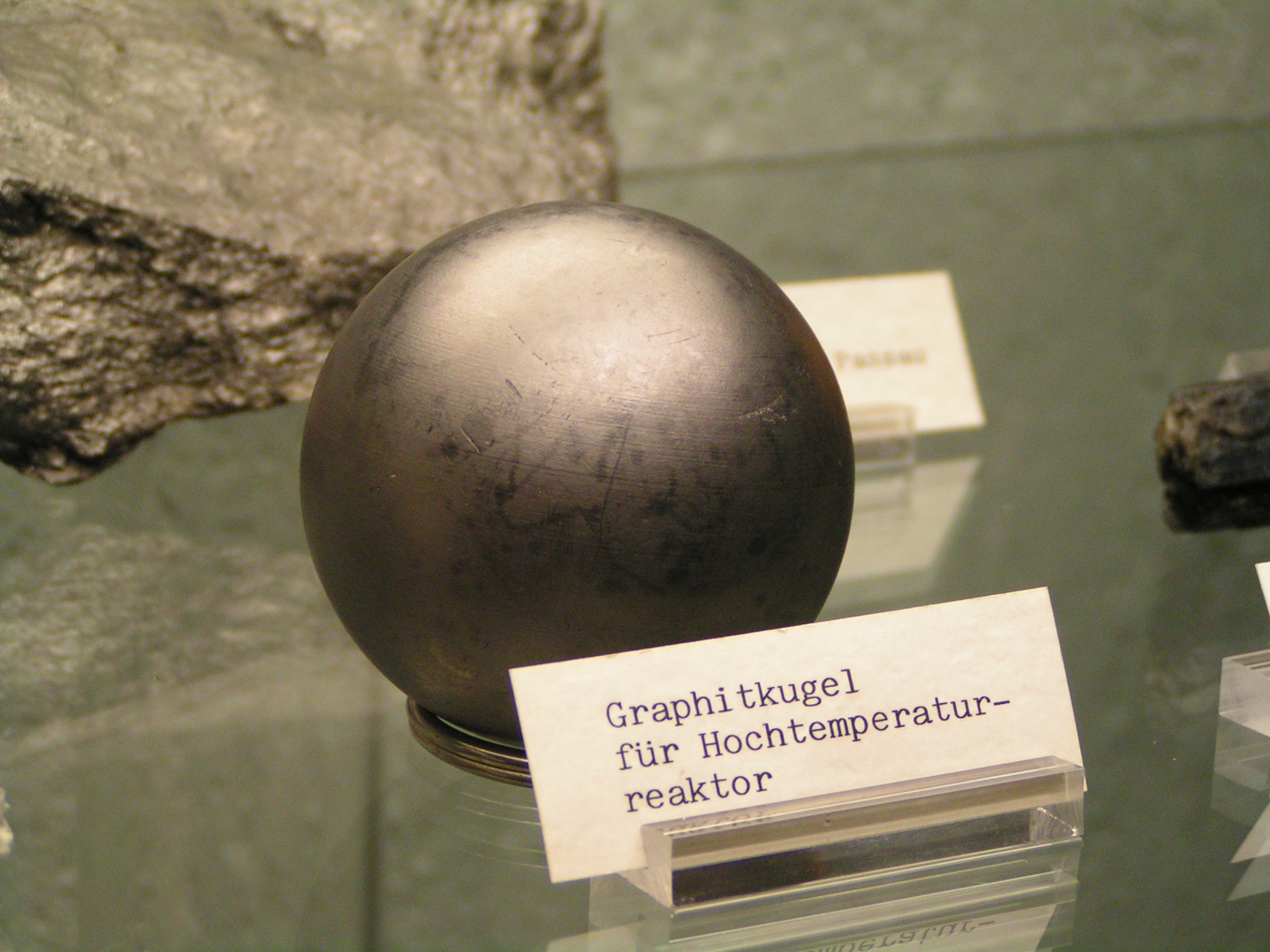
In a PBR, thousands of these fuel pebbles would be brought together to form the reactor's core. The pebbles must be cooled and thus normally helium gas is used to do so. Finally, for safety reasons the pebbles are also coated with a layer of silicon carbide in an attempt to fireproof the pebbles.
It is quite amazing...just by placing the pebbles in a specific and calculated geometry, criticality can be reached and thus we have a working nuclear reactor.
Sunday, March 27, 2011
China's Upcoming Pebble-Bed Reactor
In the wake of what has happened in Japan it is great relief for me to see that news agencies have once again started talking about nuclear technology versus nuclear disasters. For example, last Thursday the Times featured an article about a special kind of nuclear reactor that is currently being built in China, called a Pebble-bed reactor. This specific type of reactor is an HTGR or high-temperature gas cooled reactor meaning that instead of being cooled by water (like the majority of nuclear reactors out there are) this reactor is cooled with non-explosive helium gas. This means that if electricity were lost to the reactor (thus no water could be pumped for cooling), it could still be cooled by the gas. Great news right!
The Times talks about how instead of using "conventional fuel rod assemblies of the sort leaking radiation in Japan, each packed with nearly 400 pounds of uranium" the Chinese reactors will instead use "hundreds of thousands of billiard-ball-size fuel elements, each cloaked in its own protective layer of graphite"
Turns out that the "graphite coating" controls the speed of the nuclear reactions. It is truly awesome science. The Times even states that if the plant were to shut down due to an emergency, then the nuclear reactions would come to a stop all on their own (such smart little billiard balls of fuel).
So apparently this is old news...and this already started in Germany in the 1960s (but came to a halt and never preceded). Turns out that in the USA right now the government is working with Westinghouse and General Atomics to research similar ideas.
Sounds like a great idea to me. I hope to bring you more on the story...stay tuned!
The Times talks about how instead of using "conventional fuel rod assemblies of the sort leaking radiation in Japan, each packed with nearly 400 pounds of uranium" the Chinese reactors will instead use "hundreds of thousands of billiard-ball-size fuel elements, each cloaked in its own protective layer of graphite"
Turns out that the "graphite coating" controls the speed of the nuclear reactions. It is truly awesome science. The Times even states that if the plant were to shut down due to an emergency, then the nuclear reactions would come to a stop all on their own (such smart little billiard balls of fuel).
So apparently this is old news...and this already started in Germany in the 1960s (but came to a halt and never preceded). Turns out that in the USA right now the government is working with Westinghouse and General Atomics to research similar ideas.
Sounds like a great idea to me. I hope to bring you more on the story...stay tuned!
Tuesday, March 22, 2011
Media Portrayal of Fukushima Part 2 - Faster than a Speeding Bullet
I recently wrote a short post on how I felt about the media discussing the Fukushima Nuclear Plant. I would like to continue on another note but it will be brief. You see, I use GoogleNews to get my updates on the nuclear energy world...I keep it simple by typing "nuclear energy" into the news search and reading usually the first ten stories. Before Japan's latest earthquake and tsunami, results were generally positive or neutral to the nuclear movement (don't think I don't read the negative ones though...they are usually the most interesting). Following the disaster however, things took a big turn. For example, if you were to type in "nuclear energy" into GoogleNews today the first few stories that pop up are:
1. Nuclear Energy Isn't Needed
2. Catholic Expert: Japan disaster raises ethical questions about energy
---(seriously, I know right?)
3. Why nuclear and fossil fuels are disasters waiting to happen.
I'm not trying to discuss the obvious I know that it's clear to everyone that this is an opportune time for those who stand against nuclear to try to get the public to hear what they have to say, it just amazes me at how fast the media can change uh how should I put this...the way the media changes "how things seem". If I was someone who had no idea about the pros and cons of nuclear energy and looked it up a month ago...boy it would just about seem that everyone was on the nuclear bandwagon and so should I. Look it up now...are there seriously governments that allow such things to be built in their country?
It's sad but it's the way things are and the way they've always been.
Sorry for the rant.
“All media exist to invest our lives with artificial perceptions and arbitrary values” Marshall McLuhan
1. Nuclear Energy Isn't Needed
2. Catholic Expert: Japan disaster raises ethical questions about energy
---(seriously, I know right?)
3. Why nuclear and fossil fuels are disasters waiting to happen.
I'm not trying to discuss the obvious I know that it's clear to everyone that this is an opportune time for those who stand against nuclear to try to get the public to hear what they have to say, it just amazes me at how fast the media can change uh how should I put this...the way the media changes "how things seem". If I was someone who had no idea about the pros and cons of nuclear energy and looked it up a month ago...boy it would just about seem that everyone was on the nuclear bandwagon and so should I. Look it up now...are there seriously governments that allow such things to be built in their country?
It's sad but it's the way things are and the way they've always been.
Sorry for the rant.
“All media exist to invest our lives with artificial perceptions and arbitrary values” Marshall McLuhan
Wednesday, March 16, 2011
Fukushima Nuclear Power Plant-The Type of "Science" the Media Loves

Although it is my Spring Break and I am trying to enjoy it, it is hard to enjoy anything when we turn on the television and we see that Japan has been devastated. I'm sure we all, at some point, have seen the television and heard of the dire situation in Japan. And ever since the explosion at Fukushima I have been drowning in comments from friends, fellow students, and even my own family members about the future of nuclear power after this incident (my parents called earlier today and my father told me he doesn't think grad school in nuclear engineering is still a good idea).
The Fukushima nuclear plant situation is a great example for my Communicating in Science class...it shows exactly how science and technology are at the mercy of the media. When people ask me questions about the situation and how "nuclear power isn't looking so safe" they are armed with "facts" that they picked up from CNN or Fox when really they should be reading from science publications that are written by people who are respected in the field.
Therefore, I will provide some links that will allow the public to read up on the real facts concerning the nuclear plant in Japan. One link is to a page generated by Dr. Jeff King (prof. at the Colorado School of Mines) with links to other sites that give information on the topic from nuclear professionals. The second link is a facebook page also created by Jeff King that has updates on the situation.
A powerful paragraph that I found from Dr. King's page:
"6:42 PM MST 3/12, If you stop to think about it, as far as engineering disasters go, this one is so far low on the scale. On 9/11, a fully-fueled passenger jet was piloted into each of the World Trade Center towers. 2606 people died when engineering failures allowed the support beams to buckle in the resulting fires, causing the buildings to collapse. So far, Fukushima Daiichi Unit 1 has been hit with the fourth largest earthquake in recorded history, slammed by a massive tsunami, and had the top ripped off of it by a hydrogen explosion. Total death toll at/from the reactors so far? One - a crane operator who was apparently killed in the initial earthquake. (And he was actually at Fukushima Daini - a different facilty.) "
I urge you to arm yourselves with real facts on the situation, there is nothing more dangerous than knowing "a little" on the subject. And "a little" is exactly what you will get from the television. Not to be corny and predictable but an old Japanese proverb says it best, "If you understand everything, you must be misinformed."
***My heart goes out to all of those who have been affected by the earthquake.***
Saturday, March 5, 2011
Tennessee Plans For Change
If you have been keeping up with this blog you would have read my last post in which I described three US states that were pushing forward with legislation in order to have more nuclear energy in their future. Well there is good news...looks like we can add one to that list...and perhaps to the very top.
A Tennessee power company (TVA, Tennessee Valley Authority) has just released a 20 year plan detailing its interest in renewable resources to possibly lose its dependence on coal. The TVA states that it needs to meet the constantly rising energy demands of its people while also providing cleaner energy.
TVA is interested like everyone else in incorporating renewable resources such as solar and wind into its energy production budget. But shockingly TVA also announced that in 20 years it hopes that nuclear energy will represent more than half of its energy output. That's amazing and I'm glad to see that at least some states in the USA are awake and are finally realizing what is going on around them.
A powerful quote that was taken from one of the developers of the energy plan, Gary Brinkworth:
“While there may be individual components that are expensive, when you bring those all together, clearly adding those renewables gives us a stronger plan, a lower cost plan.”
A Tennessee power company (TVA, Tennessee Valley Authority) has just released a 20 year plan detailing its interest in renewable resources to possibly lose its dependence on coal. The TVA states that it needs to meet the constantly rising energy demands of its people while also providing cleaner energy.
TVA is interested like everyone else in incorporating renewable resources such as solar and wind into its energy production budget. But shockingly TVA also announced that in 20 years it hopes that nuclear energy will represent more than half of its energy output. That's amazing and I'm glad to see that at least some states in the USA are awake and are finally realizing what is going on around them.
A powerful quote that was taken from one of the developers of the energy plan, Gary Brinkworth:
“While there may be individual components that are expensive, when you bring those all together, clearly adding those renewables gives us a stronger plan, a lower cost plan.”
Wednesday, March 2, 2011
Three States Making a Move for It
I just read from another blog that three states that are not currently associated with nuclear energy have jumped on the bandwagon. According to The Energy Collective, the states of Missouri, Iowa, and Indiana have recently been making some political moves that may pave the way for nuclear reactors (Iowa does currently have one reactor). From passing new laws that make funding a lot easier to come by for Missouri and Indeana and as for Iowa the possibility of miniature reactors.
One of the big topics recently has been on states that are passing legislation to allow utility companies to add a small fee to energy bills in order to pay for nuclear reactors to be constructed. I could see this making a lot of people angry...our energy bills are high enough already right? Well lawmakers are looking at the data...a recent poll suggested that more than 70% of the USA population support nuclear energy. I guess they figure if we all want it...we won't mind paying for it. If you think about it in the end it will make energy bills lower in the future..if not for you at least for your children. So I say "yay" to this!
One of the big topics recently has been on states that are passing legislation to allow utility companies to add a small fee to energy bills in order to pay for nuclear reactors to be constructed. I could see this making a lot of people angry...our energy bills are high enough already right? Well lawmakers are looking at the data...a recent poll suggested that more than 70% of the USA population support nuclear energy. I guess they figure if we all want it...we won't mind paying for it. If you think about it in the end it will make energy bills lower in the future..if not for you at least for your children. So I say "yay" to this!
Subscribe to:
Posts (Atom)